Sovereign context for legal work

The system of record for legal findings.

ManyKind turns a matter record into findings your team can stand behind: the controlling language attached verbatim, conflicts surfaced, review recorded, and the whole history inspectable later.

For due diligence, contract review, disputes and in-house legal teams

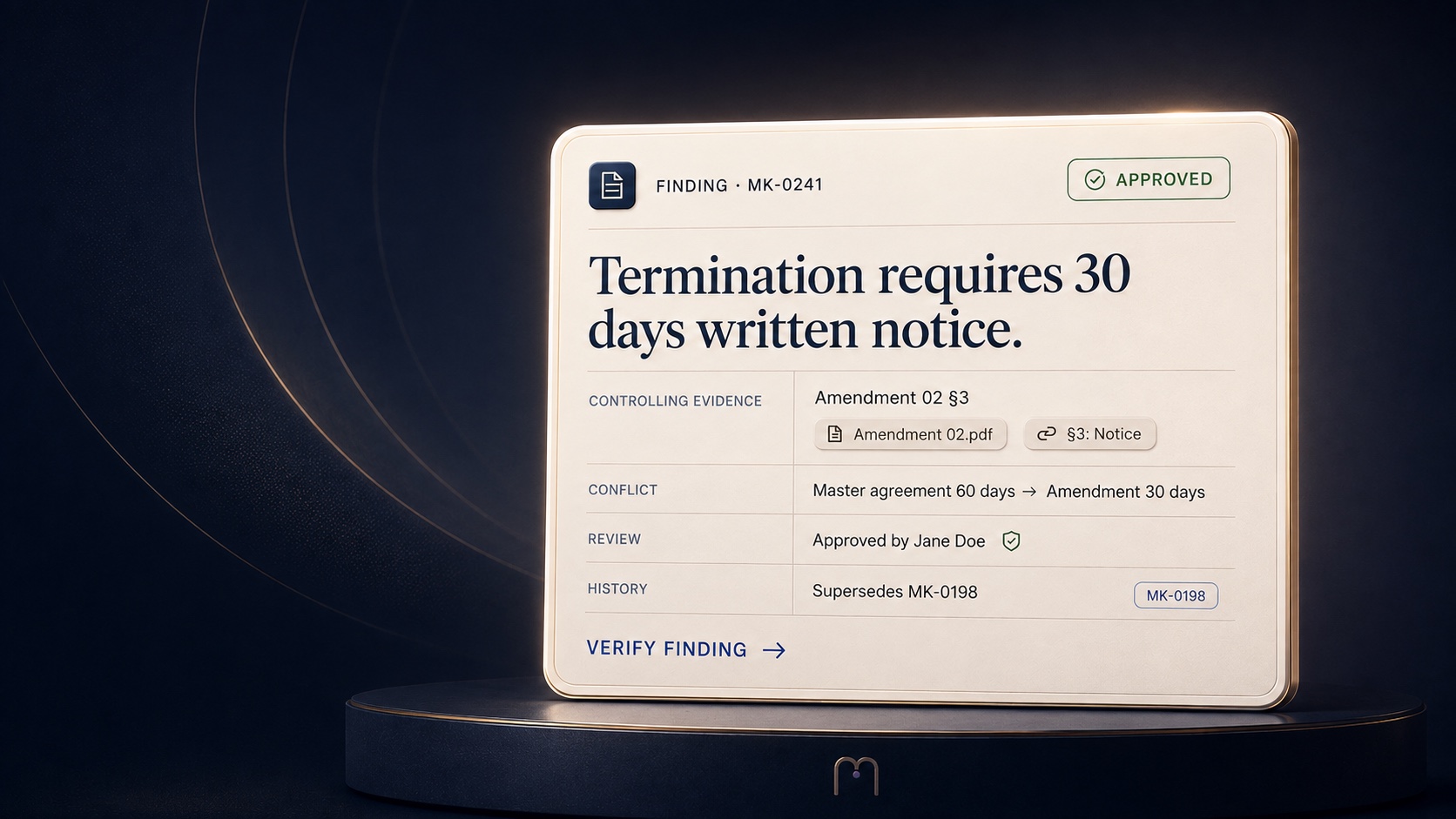
Matter TERM-118 / termination noticeFinding reviewed and approved
Finding / reviewed

Termination requires 30 days written notice.

Controlling term30 daysamendment 02 §3
Review statusApproveddecision on the record

No single document settles it. The amendment replaces the master term. Both quotations stay attached to the finding, together with the review that accepted it.

One matter record / four kinds of answer

Answers that keep the controlling language attached.

The answer usually lives in no single document. ManyKind joins the matter record, computes what it can, and keeps the exact source lines next to the conclusion. Where the record runs out, the answer says so.

Which notice period controls?

Two records disagree. Both are shown.

60 daysmaster agreement §8.2
30 daysamendment 02 §3

Exact source lines

master-agreement.pdf §8.2

Either party may terminate with 60 days written notice.

amendment-02.pdf §3

The notice period in §8.2 is replaced by 30 days.

Routed to review, not averaged

What is still owed under this engagement?

$2,400 is due September 15, 2026.

$2,40050% of $4,800
Sep 15Aug 16 plus 30 days

Exact source lines

engagement-letter.txt

The remaining 50% is due within 30 days of accepted delivery.

invoice.txt

Total fee: $4,800.

acceptance.eml

Looks great, consider it accepted, Aug 16, 2026.

3 / 3 source lines matched

What changed in the latest draft?

The indemnity cap doubled.

€500,000draft v3 §11.2
€250,000draft v2 §11.2

Exact source lines

msa-draft-v3.docx §11.2

Aggregate liability shall not exceed €500,000.

msa-draft-v2.docx §11.2

Aggregate liability shall not exceed €250,000.

Both versions kept and comparable

Was notice ever served?

Not answerable from these records.

1record requires notice
0records show it was served

What the record does and does not hold

lease.pdf

Termination requires written notice to the landlord.

no record of service

Nothing in the authorised sources states a notice, a date or a recipient.

Insufficient evidence. No answer invented.

The finding / a governed unit of work

A conclusion your team can reopen, hand off and supersede.

A finding keeps the question, the conclusion, the exact evidence, the conflicts, the gaps and the review decision together, so the reasoning survives handoffs, vacations and the archive.

01 / Record

The matter record is inventoried.

Every authorised source listed. Absences named, not assumed.

02 / Finding

Evidence becomes a structured conclusion.

Terms, dates and amounts stay tied to the exact lines that support them.

03 / Review

A reviewer inspects the decision points.

Approval goes on the record next to the evidence it accepted.

04 / Reuse

The matter comes back. The finding is already there.

Handoffs carry the reasoning, not just the conclusion.

05 / Supersede

New evidence never overwrites history.

A later finding supersedes the earlier one. Both stay inspectable.

ManyKind does not give legal advice. The lawyer owns the judgment; the finding keeps the record of how that judgment was reached.

The sovereign context standard

Sovereignty is a chain, not a slogan.

A system of record for professional conclusions has to answer five questions, in order. ManyKind is built so each answer stays yours.

Data

Who controls the records? Sources enter under access you grant, scope and revoke.

Yours
Execution

Who controls the processing? Open models on the query path, in deployments your organisation controls.

Controlled
Epistemics

Who decides what counts as evidence? Explicit rules for sufficiency, and abstention when the record runs out.

Explicit
Conclusions

Who owns the findings? They are your work product, with their evidence and review history attached.

Owned
Verification

Can you reconstruct what happened later? Sources, quotations, inputs and review decisions stay inspectable without asking a vendor.

Inspectable

Built for how legal work actually runs

The questions senior lawyers already ask.

Which document controls. What changed. Where is that stated. What did we conclude last time, and why. ManyKind turns those questions into product structure.

Faster reviewInspect decision points, not raw discovery
Handoffs that holdThe reasoning travels with the matter
Six months laterOpen the finding, not the archive
Visible conflictsDisagreement is routed to review
Honest abstentionGaps stated, never filled
Exact quotationsThe controlling line, verbatim

See it on your own matter

Bring one real matter. Leave with an inspectable finding.

A 30 minute working session with your team: one matter, one finding, review recorded. No slideware.